“The world has changed, but education has not changed with it.” - Robert Kiyosaki

Enter your details in the box to be kept updated with YOUR Education and get new ideas...

Showing posts with label article. Show all posts

Tuesday, 30 November 2010

The Day The Dollar Died - Inflation US and the currency collapse

Inflation Video 'The Day the Dollar Died' Goes Viral

This does not affect just Americans but the global population, including you!
How are you going to protect yourself against the market collapse and will you do it sooner or wait till later? And will it be too late by then?

Take out just 7-8 minutes of your day to watch the following video and share it with your friends.


http://www.youtube.com/watch?v=CbaJiwrMz1w

"On Wednesday 24th November 2010, the National Inflation Association released a shocking and stunning video entitled, 'The Day the Dollar Died', which shows the world exactly what could happen to the U.S. economy in the very near future during the first 12 hours of a U.S. dollar collapse. Although the video itself is fictional, NIA believes a U.S. dollar collapse is inevitable and there is a strong likelihood that the U.S. will experience an outbreak of hyperinflation this decade. 'The Day the Dollar Died' is a wake up call for Americans who aren't yet stocking up on gold, silver and food supplies. The U.S. dollar's day of reckoning is coming and only Americans who prepare now will survive.

On November 5th, NIA released a report with its projections for future U.S. food prices based on the recently announced $600 billion in quantitative easing by the Federal Reserve. Several days later, NIA's food inflation report was featured live on Fox News by Glenn Beck, who was recently ranked by Newsweek as the #2 most influential political figure in the country. On November 12th, NIA's President Gerard Adams was a guest on the Fox Business Network, where he spoke about the potential for food inflation to take over as America's biggest crisis in 2011.

NIA is not a political organization and does not support Republicans or Democrats. NIA exists solely for the purpose of educating Americans to the truth about the U.S. economy and inflation. Americans live in a country where 99% of those who studied economics in college were taught voodoo Keynesian economics.

Keynesian economists have the mistaken belief that all recessions are bad and must be suppressed by government interference in the free market. They believe that by the Federal Reserve manipulating interest rates to artificially low levels and printing trillions of dollars of fiat money out of thin air, they can create jobs, economic growth, and wealth. They believe that a little bit of inflation is good for an economy.

Keynesian economists fail to realize that when price inflation breaks out, it becomes impossible to contain unless interest rates are immediately raised to a level that is higher than the real rate of price inflation. Unfortunately, due to the current size and scope of our national debt and unfunded liabilities, NIA believes it will be impossible for the Federal Reserve to raise interest rates higher than the real rate of inflation. Real interest rates are likely to stay negative until the U.S. dollar collapses and is officially declared dead and worthless.

Gas and grocery bills for all Americans have been rising substantially in recent months. The average American has been seeing health insurance costs spiral out of control on an annual basis. Students have been suffering from college tuitions rising like there is no tomorrow. Massive price inflation is all around us, yet the mainstream media continues to ignore the truth and reports the government's phony CPI numbers as gospel.

Politicians in Washington from both sides of the aisle have been colluding with the media in order to brainwash Americans into believing inflation is not a problem and that their real fear should be deflation. Deflation is a good thing for middle class Americans because it means their money is worth more and their incomes and savings have more purchasing power. Inflation is only good for the politicians because it allows them to steal the wealth of middle class Americans and redistribute it to their banker friends on Wall Street who don't produce anything of real value.

There is no reason for a lawyer or banker to make more money than a farmer or factory worker. This is only made possible by the system we have today, where Americans get suckered into electing representatives who promise entitlements that the government can't afford without printing the money to pay for them. When the dollar bubble bursts and the system collapses, the free market will allow farmers and goods producers to become wealthy while lawyers and bankers go broke.

Most Americans are naive enough to believe that because the U.S. has survived for so long with such a huge national debt and continuous budget deficits, the country will be able to continue down this path forever without any consequences because after all, this is America we are talking about. The truth is, our national debt has grown by 70.7% over the past five years, compared to 41.8% during the previous five years, and 14.3% during the five years before that. Meanwhile, our GDP has grown by 17.9% over the past five years, compared to 27.5% during the previous five years, and 32.9% during the five years before that. We have gone from our GDP growing more than twice as fast as our debt, to our debt growing at nearly quadruple the speed of our GDP. A train wreck is getting ready to happen and this train wreck is literally unstoppable.

It is important to spread the word about NIA to as many people as possible, as quickly as possible, if you want America to survive hyperinflation."

Source: http://inflation.us

Wednesday, 26 May 2010

Ten Secrets to Getting Rich (part two)

You've read the first five steps... Here are the rest...

"Step Six : Give Yourself Time

It takes time to build a business as well as an investment portfolio. Building a business is not the same as getting a job. With a job, you expect to be paid soon after starting work. With a business, you may not be paid for years, if you are paid at all. That is why I recommend keeping your daytime job and starting a part-time business.

It is said that 90% of all businesses fail in the first 5 years. In my opinion, there are two main reasons for this sad statistic. One reason is lack of education and experience. Business is not something you can learn in school. Business is a combination of formal education, experience and guts.

The second reason is lack of money. We have heard the old cliche “Killing the goose that lays the golden egg”. When starting a business, many people kill the baby-goose before it’s old enough to lay the golden egg.

In other words, most small businesses are undercapitalized, which means the new business owner tries to support him or herself and often a family on a business that is not yet up and running. So the business is drained of cash when it needs it most to grow.


Step Seven : Start Small, Dream Big

In 1975, I realized that my $700 in savings was not much when compared to Mike’s hundreds of millions of dollars, which were rapidly growing into a billion dollars. Initially, I felt like giving up, saying to myself, “What’s the use. I’ll never have more than Mike.” But then I realized that if I continued with that thought process, not only would I never have more than Mike, I would never have much of anything.

I was comparing myself with Mike and trying to compete with him, rather than use him as inspiration and as a mentor. So that night I decided to dream big and start small.

Many people start small and stay small, simply because they have small dreams. In my opinion, big dreams are important because they possess ingredients vital for success: hope, desire, passion, energy, vitality, faith, drive, inspiration and creativity. These ingredients make life worth living.

So dare to dream big. Dream of all the wonderful things this world and life have to offer. Write your plan on how you can have all your dreams come true and look at the plan every day. Talk to people about your dreams, even those who criticize them. Then use their criticism to make your desire even stronger.


Step Eight: Before You Expand You Must Contract

In 1975, I knew that if I was to achieve great wealth quickly, I first needed to tighten up before I could expand. I was hurting financially because I had been sloppy with my money during the past 10 years.

In college, I’d spent a lot of money just having fun. In Vietnam, I’d developed the attitude of living life to the fullest because tomorrow I could be dead. If I was going to get ahead, I first needed to pull back a little. Instead of playing golf, rugby and tennis, I focused only on rugby.

Instead of spending every night in the clubs or watching television, I needed to get back to studying. Instead of trying to be everywhere and do everything, I decided to focus. I began doing more — of fewer things.

So, regardless of what you did yesterday, if you want to do better financially tomorrow, you may need to forgive your past, tighten up your activities today, so you can have a bright and prosperous tomorrow. To expand, you must first contract.


Step Nine : Get Bigger Faster

The problem with a small business or small investments such as one single family rental, is that you have to do all the work. You do all the work because there is not enough money to support paid management. So you own it and manage it.

Very often, a person begins to buy real estate and soon quits because the work is hard and the pay is low. They started with a small plan and stayed small.

For business or investing to work for you, in most cases you must get big. Instead of buying only two rental properties, plan on acquiring at least 20 properties as soon as possible. (But make sure you know what you’re doing first.) With 20 properties you can afford professional management, if the cash flow is strong, or you can trade the 20 units into one larger apartment house or office building.

The same goes with businesses, especially franchises etc. If you have only one franchise, you are the chief cook, bottle washer, owner and manager. If you have 20 of them, you have a chance of finding freedom faster.

The people who dream small, think small, and work small, work the hardest and are paid the least. So that night in 1975, I vowed to focus, acquire education, gain experience, start small and get big as quickly as possible.

I always remind myself of my rich dad’s words: “The bigger the asset you build, the less you work and the more money you make.”


Step Ten : The More You Share, The Richer You Become

In 1975, I knew that if I wanted to acquire great wealth quickly, I had to be a person who shared. I had to be generous. If I was greedy, stingy or tight, it would take me longer to attain great wealth.

So, I decided to operate out of the B (Business Owner) quadrant, rather than follow my poor dad’s ideas on labor unions and protectionism. I knew that I needed to focus on doing more for less money, for more people. I needed to focus on sharing as much of my wealth with as many people as possible.

So Step Ten is to be generous and share. If you do that, you will become far richer than those who work only for themselves.

Every day we are presented with multiple choices, so that we must continually choose and re-choose our chosen path. If you choose to be wealthy, use these ten steps to find your path and to stay on track."

By Robert Kiyosaki

Friday, 21 May 2010

Ten Secrets to Getting Rich (part one)

"Today, because of the multitude of choices we all have, it is easy to get distracted from where we want to go in life. I offer you a few suggestions on how to find your path and stay on your path to great wealth, if you should choose to do so.

One night in 1975, I sat in my little apartment and began to choose the path I was now to take. I had to again decide which dad’s path I would follow, my rich dad’s or my poor dad’s. I had been off track for 10 years and it was now time to get back on track.

These are some of the decisions I made and have continued to make over the years.

Robert Kiyosaki

--------

Step One: Decide to Be Rich

That night in 1975, I had to stop feeling sorry for myself and decide again to be rich. I went over some of the lessons my rich dad had given me - lessons that were more important than money, because they would ultimately create the financial empire I wanted.

I sat quietly that night and my lessons began all over again. I could hear my rich dad talking. “The only difference between the rich, poor and middle class,” he said, “is the kind of lifestyle they want. You don’t have to be psychic to tell a person’s future. If you listen to the words a person uses, they will tell you their future.”

Rich Dad believed that words were a person’s most important tool. He constantly reminded me to watch the words I spoke, simply because he believed that the words you speak and the words you think ultimately become the world you live in. He often quoted the Old Testament: “And the word became flesh”.

So that night, I remembered Rich Dad reminding me to listen to different people’s words. I noticed that poor people often said:

“I just want enough money to pay the rent.”

“I need a few dollars to get to the next pay day.”

“After I pay my bills, I don't know how my family can afford to eat.”

People who used words such as these, often focused only on financial survival. Rich Dad often referred to these people as “poor” people, because they were poor managers of money. So a person who thought or spoke words such as these was constantly fighting for financial survival, regardless of how much money they made.

The middle class used different words because they had different ideas about how to use their money:

“Our home is our most important asset and our largest single investment.”

“We’re setting a few dollars aside every month, so we can afford the down payment on our dream home.”

“We’re saving money for our children’s college education and our retirement.”

I noticed that the middle class focused on comfort. That is why so many of them say, “I don’t want to be rich. I just want to be comfortable.”

That night, I recalled the words my rich dad’s rich friends used:

“How did you finance your shopping center? Did you syndicate it with a joint venture partnership or did you go to a hard money lender for the interim money?”

“My underwriter has a new private placement, pre-IPO offering. Do you want a position in it?”

“I bought the shares through my corporation because the long-term tax consequences are better.”

The rich used the vocabulary found in the asset column. Rich Dad said, “The rich are rich because they are not focused on day-to-day short-term survival, or the expense column as the poor are. Nor are the rich focused on comfort and the acquisition of liabilities using credit, as the middle class is.

The rich are rich because they focus on the long-term acquisition of assets... assets such as stocks, bonds, businesses and income producing real estate. Many times the rich will forsake meals, a steady pay check, a vacation, or the comfort of a nice home, to build or acquire real assets.”

So decide to be rich, even if you are broke and penniless today. In Rich Dad Poor Dad, I wrote of the difference between being poor and being broke. Poor is a state of mind where thoughts such as “I can’t afford it” or “Live below your means” come from. Being poor is eternal but being broke is temporary.

The opening chapter of The CASHFLOW Quadrant is called, “Why Don’t You Get a Job?” It begins with my wife Kim and I being homeless for about 3 weeks. Even though we were virtually out of money, we continued to strive to become rich, to build a business and invest through that business.

Today, even though we have plenty of money and several businesses, nothing much has changed. We continue to build businesses, reinvest in our businesses and invest through those businesses.

In The CASHFLOW Quadrant, I wrote about Be-Do-Have. “Be” is the most important part of the three word formula. Most people want to “Have” what the rich have, but they often are not willing to do what the rich “Do” to have what the rich “Have”.

So whether you have money or not, it is important to “Be” rich if you decide to do so, which means being willing to make being rich more important than merely surviving financially or being comfortable.


Step Two: Decide What Kind of Money Problems You Want

There are only two kinds of money problems: not enough money or too much money. Unfortunately, the kind of money problem most people know is not enough money.

Rich Dad stressed that his son Mike and I know not only how to make money but what to do with the money we made. Rich Dad said, “Most people know how to work for money, but they do not know how to have people and money work for them.” So he taught us how to plan on having too much money.

He said, “If you want to be rich, you must make sure your excess money creates more excess money. You must know what to do with your excess money before it gets to you. Most people, when they receive any excess money, spend it foolishly or just park it in the bank.”

So decide what kind of money problems you want.


Step Three: Write Your Plan and Follow It

After choosing between being rich, poor or middle class, and then choosing between too much money or too little money, it’s time to write your plan.

If you have chosen to be rich, even though you are broke today, and have decided to have the problem of too much money, read on. If you do not plan to be rich or to have too much money, then you need not read any further.

Rich Dad’s plan started with a few basic goals:

1. Change the characteristic of your income. Start a part-time business.

2. Change the characteristic of your expenses. Convert personal expenses into business expenses.

3. Place your business inside a legal entity.

4. Have your business buy your assets.

5. Harness the power of reinvesting.

If you’re willing to be a little uncomfortable to become very rich and retire early, develop your plan — even though you may be broke, but not poor, today. And if you are already rich, Rich Dad’s plan may help you become richer and happier...even beyond your wildest dreams.


Step Four: Decide on Where You Want to do Your Banking

Rich Dad often said that you could tell the difference between the rich, poor and middle class simply by where they went to get their money or to do their banking.

Rich Dad said, “A poor man’s bank is a pawn shop.” A pawn shop lends money on “assets” that a banker would not loan money on. When a poor person is short of cash, they will often go to the pawn shop and put their chainsaw, microwave oven, jewelry, TV sets, tools, or watches up as security.

The pawn shop gives them cents on the dollar, because what the poor spend their money on is not worth anything after they buy it anyway. The pawn shop makes money by charging legal usurious interest rates.

The middle class has the creditworthiness to use banks, savings and loans, or credit unions for their lines of credit. A popular form of credit for this group is the credit card, which is easy to obtain.

The rich also use banks. But they often use different banks. They use the services of investment bankers, or find private capital from wealthy individuals, or money from institutions such as pension funds, insurance companies or the stock market.

The rich, if successful as business people, have fewer problems raising large sums of money and at better interest rates. So decide where you will do your banking.


Step Five: Choose Your Friends and Partners Wisely

One of the reasons the rich get richer is because they spend time with other rich people. Most of my best investments come from my rich friends, not from my stock brokers or real estate brokers. It is important to know if a person’s aspirations are to be rich, comfortable or simply survive.

Friends who merely want to be comfortable or survive will not understand why you want to be rich and may unconsciously pull you down. And besides, the investment tips I get from people who only want to be comfortable are often tips on investments that no one else wants.

How do you find people who are rich or want to be rich? Rich Dad had a simple answer: “It’s what you know that determines who you know. If you want to change who you know, simply change what you know.” So the most important investment you can make is in your financial education and financial experience. Invest in that first and the people you spend time with will change."
By Robert Kiyosaki


Take time to read and understand the steps above... 6-10 will follow in the next post.

Thursday, 1 April 2010

Rich Dad Predictions for 2010

2010: The Best of Times or the Worst?

Below are the Predictions for 2010 posted by Robert Kiyosaki on Tuesday, December 29, 2009.  They are definitely worth a revisit or a read if you missed them the first time round, as we are now well into the year.

“It was the best of times. It was the worst of times.” – Charles Dickens

"Is the recession over? Are happy days really here again? Paraphrasing Dickens, my answer is, “For people who are prepared, 2010 will be the best of times. For many, 2010 will be the worst of times.”

The following are a few of my predictions and reasons behind them…

Prediction #1The real estate market will crash again.

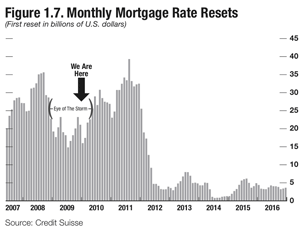
Pictured above is a graph of mortgage resets. In simple terms, a mortgage reset is when a mortgage comes due. In normal times, refinancing was a simple process…but these are not normal times. Some points of interest:
1.  In September 2008, the mortgage resets hit $35 billion that month. That was the exact time the financial crisis hit. When people could not afford to refinance and began to default, the stock market and banking industry crashed. 
2.  The eye of the storm: In the summer of 2009 mortgage resets were low -- around $15 billion a month. This is when optimists began to see “green shoots” in the economy. The green shoots were the eye of the storm.  In 2010, as I see it, the second half of the financial hurricane hits. By late 2011, the resets climb to nearly $40 billion a month. The storm will not end until 2012.
3.  The first half of the storm was primarily due to subprime defaults. The second half of the storm will hit more solid homeowners. The question is, can they weather the storm? Will Mac Mansion foreclosures be next?
4.  In America, there are over 40 million people who own more than two homes. Can they afford to carry and refinance two or more mortgages?
5.  Since home values have gone down, many homeowners will find they owe more than their home(s) are worth. Will the bank be kind to them?
6.  The time for using your home as an ATM is over. This is crushing retailers and retail real estate. Shopping centers are in trouble. Strip malls are empyting as shopkeepers close -- permanently. This will lead to the crash of the office, warehouse, and other commercial properties.
My prediction:  Obviously these are the best of times if you are a buyer of distressed properties and the worst of times if you are a seller.
Other things I am watching for in 2010:
1. Will China crash? America’s crash has hit China in the gut. The Chinese are laying off millions of workers. Only massive government bailout is keeping the economy afloat. The Chinese boom will eventually go bust…but will it bust in 2010? Only time will tell.
2.  When America stopped importing from China, China stopped importing from the rest of the world. This affects Asian countries as well as Australia, Brazil, and other suppliers of raw materials.
3.  Fed Chairman Ben Bernanke is replacing toxic debt with new debt. By protecting his friends in the mega-banks, he is turning the U.S. into a zombie nation. The recession is over, but America is entering an era we will be calling The New Depression, a period when the rich become extremely rich but everyone else becomes poorer. Taxes will kill anyone working for a paycheck.
4.  The U.S. dollar will grow weaker. If the dollar strengthens, we will have more unemployment because our goods become too expensive and we will export less. 
5.  The deficit will increase.  The bailouts for the rich are killing the economy.


6.  Israel may attack Iran. Israel will not tolerate Iran developing nuclear power, even if Iran claims it is for peaceful purposes. If there is an attack, oil prices will go through the roof. 
7.  Dead cat bounce. The current stock market rally will probably turn into a dead cat bounce. If the Dow drops below 6500, 5,000 may be the next stop.

The Best of Times
I know I sound painfully pessimistic. I know my predictions are bad news for most people. Yet, for others, bad news is good news.
The following are the bright spots for people who are prepared.

Prediction #2: Gold, silver, and oil will continue to be safe investments in 2010.
The following recaps the year-end prices of gold and silver:
            YEAR             GOLD                        SILVER
            2000               $  273                         $  4.57
            2001               $  279                         $  4.57
            2002               $  348                         $  4.78                       
            2003               $  416                         $  5.92
            2004               $  438                         $  6.79
            2005               $  518                         $  8.80
            2006               $  638                        $12.78
            2007               $  838                        $14.77
            2008               $  882                        $11.33
            2009              $1100  (approx)     $17.50  (approx)
In 2009, the Dow rose approximately 18%. Gold rose approximately 25%. Silver rose approximately 50%. 
By the end of 2010, I predict gold will be at $1,775 an ounce, silver at $24 an ounce, and oil at $85 a barrel. If Israel attacks Iran, these predictions will be blown away.
Prediction #3: The next market to crash will be commercial real estate.
Cash flow positive real estate will be even more affordable. 2010 through 2012 will be a real estate buffet for those with cash and access to credit.

My Personal Investments
As I stated in 2002, “You have up to the year 2010 to become prepared.”
The following are things I have done to prepare myself:
1. I started The Rich Dad Company in 1997 because I saw this crisis coming. For the past three years, I have tightened internal controls and prepared for global expansion via a franchise distribution system. The company is debt free with strong income.
2.  2009 was my best real estate year to date. With the Fed handing out large sums of money and pension funds looking for projects to invest in, my real estate holding company has acquired tens of millions of dollars for acquisition of bankrupt properties and development projects.  Development projects are affordable again, as labor, material, and land costs are low and the government is generous with 40-year, low interest, non-recourse loans. People still need a roof over their heads.
3.  My oil development projects have done well. We drilled three wells and hit oil on two of them. Government tax breaks for oil exploration remain generous, even for dry holes.  Even if the economy crashes, we will still burn oil.
4.  I took 90% of my money out of the stock market in 2007. If the Fed raises interest rates, the stock market and real estate market will collapse.
5.  I loaded up on gold and silver between 1996 and 2004.
6.  With the Fed printing trillions of dollars, cash is trash and savers are losers. As soon as I have excess cash I invest in oil, real estate, gold, and silver.
7.  In a zero-interest-rate environment, debtors are winners…but only if you have good debt…debt that’s paid by tenants.

In Conclusion
A few years ago, Japan was ‘King of the Financial World.’ Japan’s economy was the world’s second largest economy -- till the bubble burst in 1990.  Japan’s budget went into deficit in 1993. Since then, the deficit has averaged 5.4 percent of GDP per year. As a result, Japanese government debt is now 200 percentof GDP today. The U.S. is following Japan, and China will follow the U.S.
We will not see much inflation because the Fed is not able to print enough money to replace the losses from the burst of the credit bubble. Also, factories have too much excess capacity due to lack of demand, which means prices for consumer goods will remain low and unemployment will remain high. Instead, we will see inflation in gold, silver, oil, some stocks, some real estate sectors, and food -- not because values are going up but because the dollar is going down.

Welcome to The New Depression. And may these times be the best of times for you." - Robert Kiyosaki   

Source: http://finance.yahoo.com/expert/article/richricher/211091